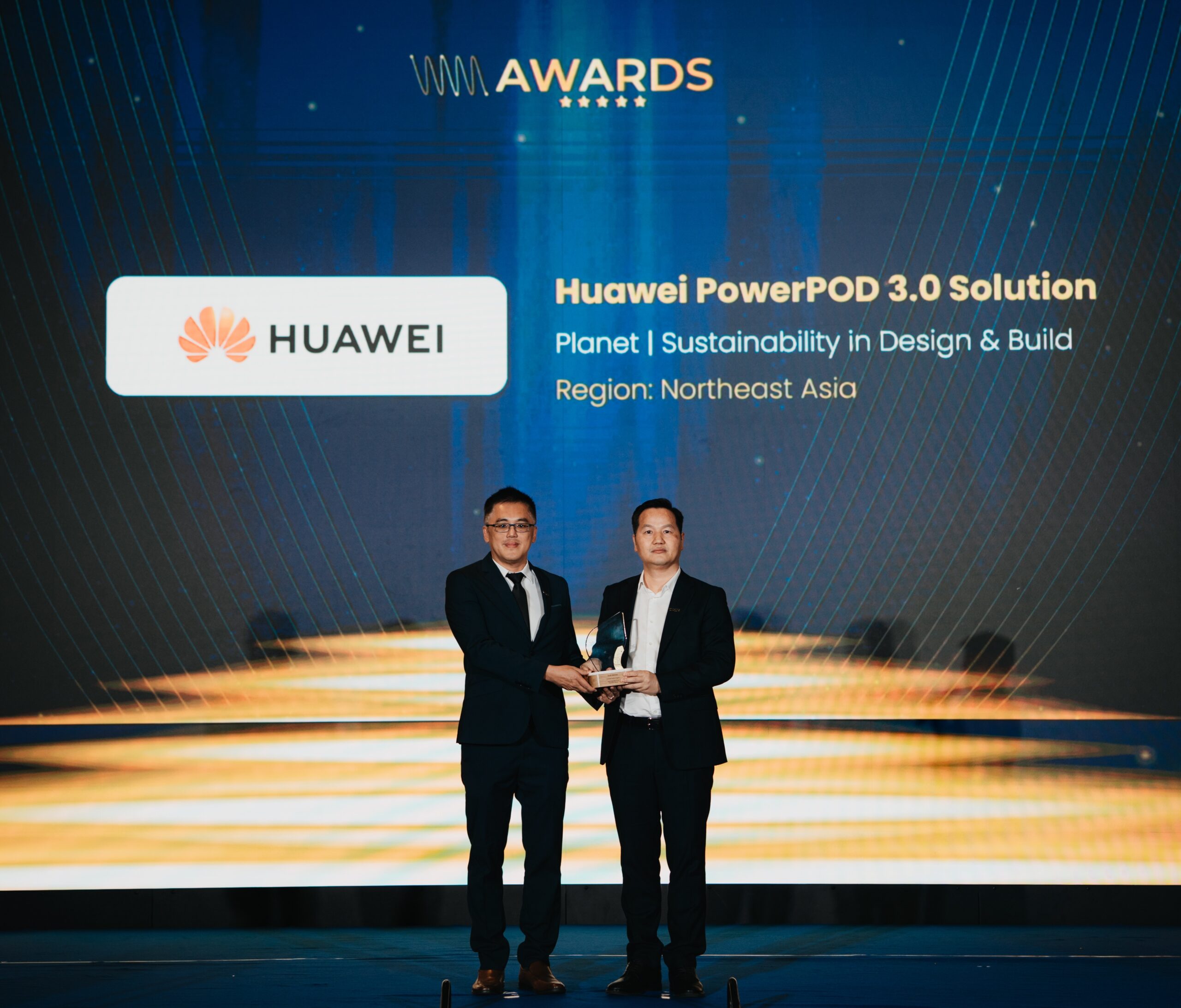
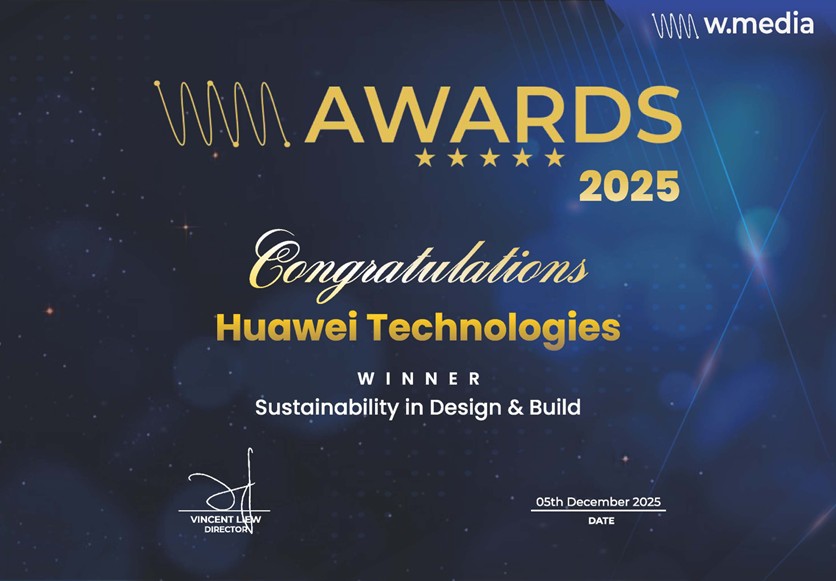
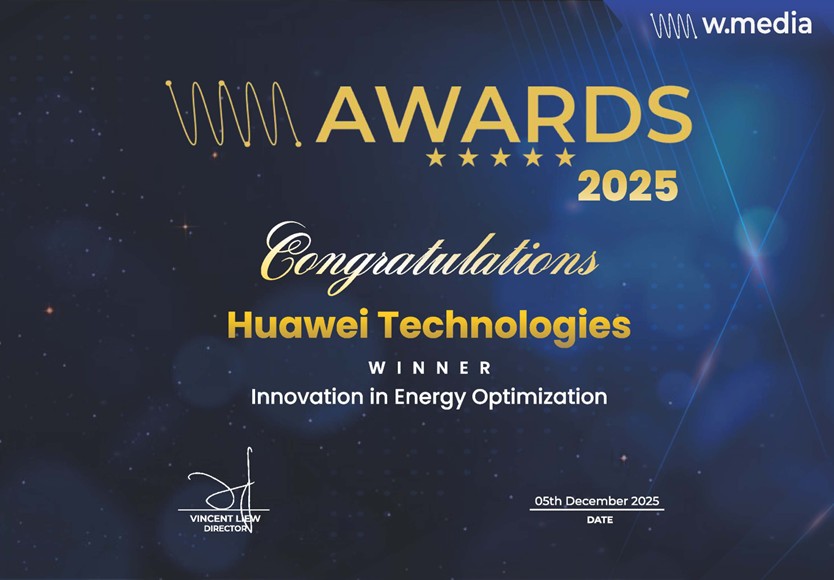
On December 5, 2025, the Asia Cloud & Datacenter Awards 2025 organized by w.media, a top-tier media publisher and community hub in the data center industry, successfully concluded in Singapore. Among the winners was Huawei Digital Power, which was granted the Sustainability in Design & Build, and Innovation in Energy Optimization awards, in recognition of its innovative technologies in artificial intelligence data centers (AIDC) power supply and thermal management.
The w.media Awards is a badge of honor in the cloud and data center sectors. It celebrates excellence among projects, technologies, and teams in the digital infrastructure field across Asia Pacific, with the aim of promoting industry transformation and innovation. The Sustainability in Design & Build award acknowledges dedication to sustainable practices in the planning, design, and construction of digital infrastructure, while the Innovation in Energy Optimization award recognizes innovative technologies that significantly improve the energy efficiency of digital infrastructure.
In recent years, the demand for training and inference of AI models has skyrocketed, and the construction of global AIDC has been booming. AIDCs are characterized by high power density and high energy consumption. Notably, high density brings complexities beyond high-density deployment of devices and creates new challenges to power supply and cooling systems. Through continuous innovation in AIDC power supply and cooling chains, Huawei aims to build an end-to-end power supply solution as well as an end-to-end thermal management solution, so as to enable accessible power supply and smooth heat dissipation and maximize tokens per watt.
Huawei PowerPOD wins the Sustainability in Design & Build award
In the AI era, the power density of a data center increases to hundreds of kW, and will exceed 1 MW in the future. This rise in power is down to the sharp increase in cables inside cabinets and higher deployment complexity, which demand high-density and converged power supply and distribution systems. Additionally, AI training and inference services need to operate without interruption 24/7, posing higher requirements on the reliability and energy efficiency of the power supply and distribution system.
By redesigning the power supply and distribution link, Huawei builds a hyper-converged PowerPOD solution that continuously drives AIDC power supply systems toward higher density, efficiency, and reliability. w.media’s Sustainability in Design & Build award is a testament to the industry’s recognition of Huawei’s technical innovation and implementation capabilities in data center power supply and distribution.
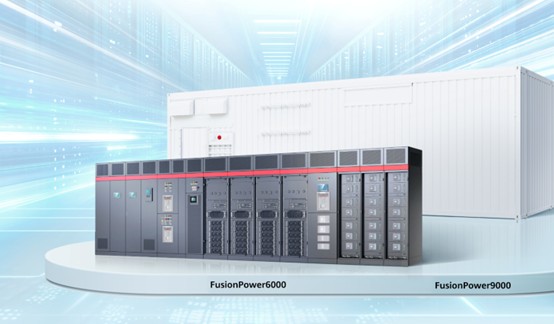
Through engineering productization and product modularization, Huawei PowerPOD enables 90% of onsite work to be completed in the factory. This greatly shortens the time to market (TTM) and avoids uncertainties during onsite construction from the source, improving delivery quality and efficiency while facilitating quick rollout of AI services. With its converged design, Huawei PowerPOD solution builds one power system per aisle or container, greatly reducing the footprint and significantly improving the space usage effectiveness (SUE).
The AI-based prediction technology is employed to implement full-link visualized management. The solution also provides functions such as low-load high temperature warning of copper bars and service life prediction of vulnerable components. This shifts maintenance from a passive to a predictive model, significantly improving system reliability.
Currently, Huawei PowerPOD solution has been widely deployed in Malaysia, Finland, and Norway, helping build benchmark AIDCs that are reliable, agile, and sustainable.
Huawei TMU wins the Innovation in Energy Optimization award
As the power density of racks in AIDCs keeps increasing, traditional air cooling technology can no longer provide the efficient heat dissipation required by high-density devices. Therefore, liquid cooling is no longer optional—it’s essential.
By redesigning the cooling link, Huawei has developed the innovative thermal management unit (TMU), achieving a technological leap from a “smart cooling heart” to “heart + brain.” Huawei TMU carries heat exchange and flow distribution functions and works as the “smart cooling brain” to ensure efficient and reliable liquid cooling. Winning this award validates the superior energy efficiency of Huawei’s thermal management solution for AIDCs.
The TMU uses efficient plate heat exchangers that reduce the approach temperature to as low as 3°C (the lowest in the industry). Combining iCooling intelligent optimization and intelligent teamwork control, Huawei TMU can dynamically allocate cooling capacity on demand, achieving cooling with optimal energy efficiency.
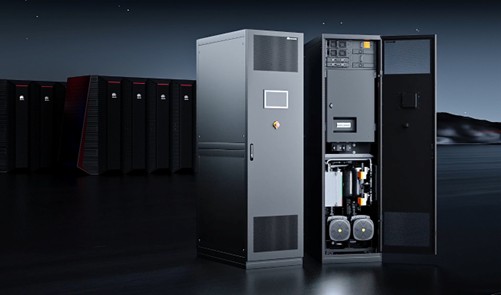
Huawei TMU adopts the industry’s first dual AC/DC power supply architecture, achieving seamless switching between primary and backup power with zero cooling interruption. All key components adopt a 2N redundancy design to support hot-swappable maintenance within 1 minute. A single failure does not affect the operation of the entire system, making AIDCs’ cooling more efficient and reliable. Additionally, the expansion tank supports one-click self-check. This eliminates the need for regular shutdown detection, making operations and maintenance (O&M) easier and more efficient.
When accepting the award, Steve Kim, President of Data Center Facility & Critical Power Marketing, Sales and Services, Huawei Digital Power, said that securing two w.media awards this year represents both a great honor and a powerful motivation. He noted that this is not only an important recognition by the industry for Huawei’s power supply and thermal management solutions for AIDCs, but also a strong motivation for Huawei to continue innovating and to lead the industry’s high-quality development with more cutting-edge technological solutions.
The AI era offers boundless opportunities. Huawei will focus on innovation in power supply and thermal management technologies for AIDCs to build more competitive full-scenario AIDC solutions. Huawei’s goal is to help build AIDCs that are reliable, agile, and sustainable—enabling each watt to produce more tokens and powering the digital era forward.